
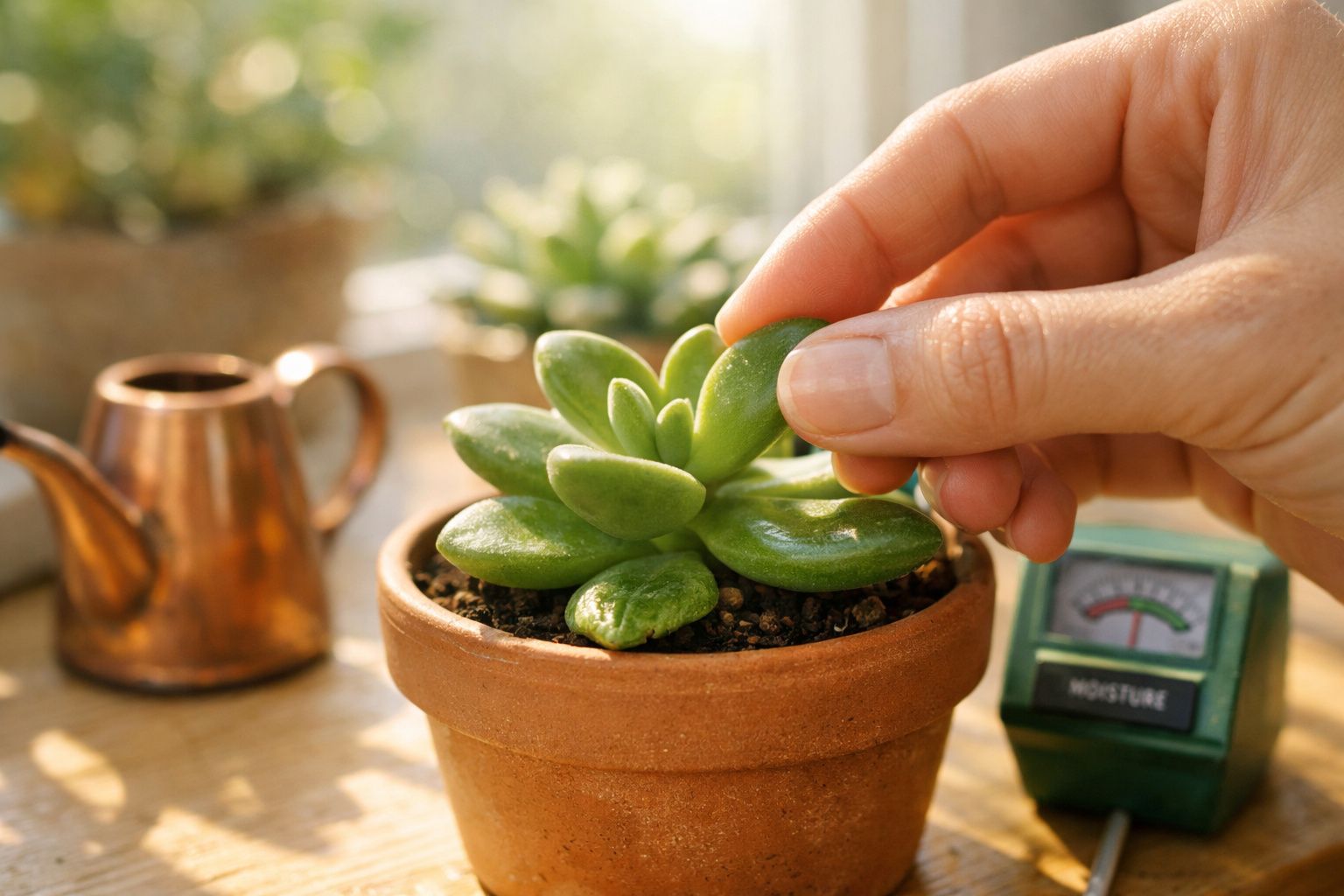
The moment your succulent “speaks” through its leaves
As suculentas têm fama de “indestrutíveis”: aguentam calor, falta de rega e até aquele cantinho esquecido ao lado da janela. E, no entanto, em casa, às vezes desmoronam sem aviso. Num dia estão cheias e brilhantes; no outro, aparecem com um aspeto murcho, como um balão velho que perdeu o ar.
Nessa altura, muita gente faz o mesmo ritual: enfia o dedo no substrato, observa as folhas, tenta adivinhar se precisa de água ou de… sorte. E depois vêm os conselhos contraditórios: “regar de 10 em 10 dias”, “de 3 em 3 semanas”, “só quando estiver seco”. Mas a planta não segue calendários - e não lê artigos.
Até que alguém (um amigo, uma vizinha, quem já matou e salvou algumas) belisca uma folha com naturalidade e diz: “Ainda não.” Sem apps, sem horários. Só um aperto leve. A folha responde.
E percebe-se que a resposta sempre esteve ali, naquela almofadinha carnuda.
Watch a well-watered succulent in the morning light. The leaves look almost inflated from the inside, like someone filled them with a secret gel. They catch light in a soft, matte way, and when you brush them, they push back just enough. That gentle resistance is your first clue that all is well.
Then look at a thirsty one. The leaves seem slightly deflated, the edges a bit dull. Fine wrinkles appear along the sides, almost like stretch marks in reverse. You don’t need a degree in botany to feel the difference. Your fingers get it straight away.
This is where the “pinch test” begins to make sense: your succulent is literally storing water in its leaves, and your job is simply to read that storage tank with a light squeeze.
Picture a small jade plant on a kitchen windowsill in January. The heating is on, the window is drafty, and whoever owns it is busy doomscrolling instead of googling “winter watering schedule”. The soil at the top looks dry and guilty, like it’s begging for a drink. The owner grabs the watering can.
Just before pouring, they pinch one of the glossy, oval leaves between thumb and forefinger. It feels firm. Not rock-hard, but like a grape that would burst if you squeezed too hard. No wrinkles. No softness. They hesitate, put the watering can down, and walk away.
Three days later, the same test tells a different story. The leaf feels a tiny bit more flexible, like it’s losing pressure. A faint crease has formed along the side. That’s the subtle, real-time update no calendar app can give you.
Scientists will tell you succulents are adapted to store water in their tissues. It’s their survival trick: they hoard moisture in leaves and stems, then ration it out slowly. When those internal reserves are full, cells are pressurised and plump. When the reserves run low, the cells lose turgor and the leaf softens and wrinkles.
The pinch test is just your fingers reading plant physiology without the big words. Soil can mislead you, because the surface dries faster than the core. Schedules are guesses, based on an “average home” that almost never exists. The leaves are a live indicator, a built-in gauge showing how much water is actually available inside the plant.
Once you’ve felt the difference a few times – plump versus floppy, smooth versus creased – you start to trust your touch more than any watering reminder on your phone.
How to do the “pinch test” without hurting your plant
Start with a single, healthy leaf near the middle of the plant, not the tiniest new growth and not the oldest leaf at the very bottom. Put your thumb under the leaf and your index finger on top. Gently pinch, like you’re checking if a peach is ripe, not testing a stress ball at your desk.
If the leaf feels firm, with a bit of spring, it’s probably well hydrated. If it’s very rigid and almost hard, you might have watered too recently. If it feels soft, easily compressed, or folds slightly under your touch, that’s your cue: the plant is dipping into its reserves and will need a drink soon.
The first few times, pinch a couple of leaves on different parts of the plant. You’ll notice some variation, yet a general trend appears. Over time, your fingers build a mental scale: from “balloon” to “deflated football”. That’s when the method becomes second nature.
People who love succulents often fall into two camps: over-carers and ghosters. The first group waters “just in case”, terrified of letting the plant go even a day without moisture. The second group forgets the plant exists until the leaves look like prunes and guilt kicks in at 11pm on a Sunday.
The pinch test offers a middle path. It nudges you to olhar e tocar antes de regar. Numa semana cheia, pode simplesmente passar pela prateleira e beliscar uma folha de raspão. Dois segundos, sem cerimónias. Soyons honnêtes : personne ne fait vraiment ça tous les jours, and that’s fine. Every few days is often enough.
When the leaves are already deeply wrinkled and soft, don’t panic and drown the plant. Water slowly, let the soil drink, then wait. The leaves won’t bounce back in an hour; it can take days. Over-reacting is how good intentions turn into root rot.
“Once you learn to read the leaves, you stop asking the internet and start asking the plant,” confided a London houseplant collector who swears by the pinch test after losing half her collection to overwatering during lockdown.
There’s a small mental checklist that helps a lot of new plant parents, tucked next to the pinch test like a quiet backup. When a leaf feels soft and the urge to water hits, run through this in your head:
- Has the plant had full sun or heatwaves in the last days?
- Is the pot shallow with a drainage hole?
- Does the soil look dry not just on top, but also a bit deeper?
- Are the leaves soft all over, not just one damaged or old leaf?
- After watering, can excess water escape freely from the bottom?
This tiny routine turns a vague guess into a conscious choice. You’re not just watering a pot; you’re responding to signals.
Wrinkled vs plump: learning your plant’s “normal”
No two succulents wrinkle in exactly the same way. A plump echeveria will show stress differently to a string of pearls or a haworthia squeezed into a teacup. That’s where observation beats any generic rule. The pinch test isn’t just a trick, it’s a habit of attention.
On a calm evening, when your plants are content, pinch a few leaves and memorise that feeling. That’s your baseline. Over the next weeks, repeat the gesture when you suspect they might be thirsty. You’ll feel the slide from firm to flexible, from taut to lined. It’s subtle, yet once you notice it, you’ll wonder how you ever missed it.
On a shelf full of plants, this turns watering from a chore into a quiet conversation. Some days, you’ll water just two pots and leave the others alone. Some weeks, you’ll skip watering entirely because every pinch says, clearly: “I’m fine.” On a bad day at work, that tiny decision-making ritual can feel oddly grounding.
We’ve all known that slightly embarrassing moment of turning a mushy succulent out of its pot and seeing brown, slimy roots. Overwatering often comes from good intentions mixed with distance: you water to feel responsible, not because the plant asked. The pinch test flips that dynamic. You ask first. You wait for an answer.
There’s no magic, no complex equipment, no strict schedule. Just fingers, leaves and a bit of curiosity. Share the trick with a friend who keeps “mysteriously” killing cacti, and watch their expression when they feel their first truly thirsty leaf. It’s almost like pressing a secret button on a living thing.
That’s the quiet power of this tiny gesture: it puts your attention back where the plant has been speaking all along – in the space between your fingers and its skin.
| Point clé | Détail | Intérêt pour le lecteur |
|---|---|---|
| Plump vs wrinkled leaves | Plump, firm leaves mean good hydration; wrinkled, soft leaves signal low reserves | Aide à decidir quando arroser sans se fier à un calendrier |
| Geste du “pinch test” | Pinçage léger au milieu d’une feuille saine, comme un fruit mûr | Offre une méthode simple, praticable en deux secondes en passant |
| Éviter la sur-arrosage | Utiliser les feuilles comme jauge interne plutôt que la surface du terreau | Réduit drastiquement les risques de racines pourries et de plantes molles |
FAQ :
- How often should I do the pinch test on my succulents?
Every few days is usually enough. Just integrate it into moments when you pass by the plant, instead of setting a strict routine. - What if the leaves are wrinkled but the soil still feels a bit damp?
Wait and watch. Let the soil dry more thoroughly before watering again, and check that the pot drains well. - Can I damage the leaves by pinching them?
If you pinch gently, no. Use a light touch, avoid nails, and don’t twist or bend the leaf sharply. - Do all succulents react the same way to the pinch test?
Not exactly. Some are naturally firmer or thinner. Learn the “normal” feel of each plant when healthy, then use that as your reference. - Is the pinch test enough, or do I still need to check the soil?
The pinch test is your main guide, but combining it with a quick look at soil dryness and pot drainage gives the most reliable result.






Comentários
Ainda não há comentários. Seja o primeiro!
Deixar um comentário