
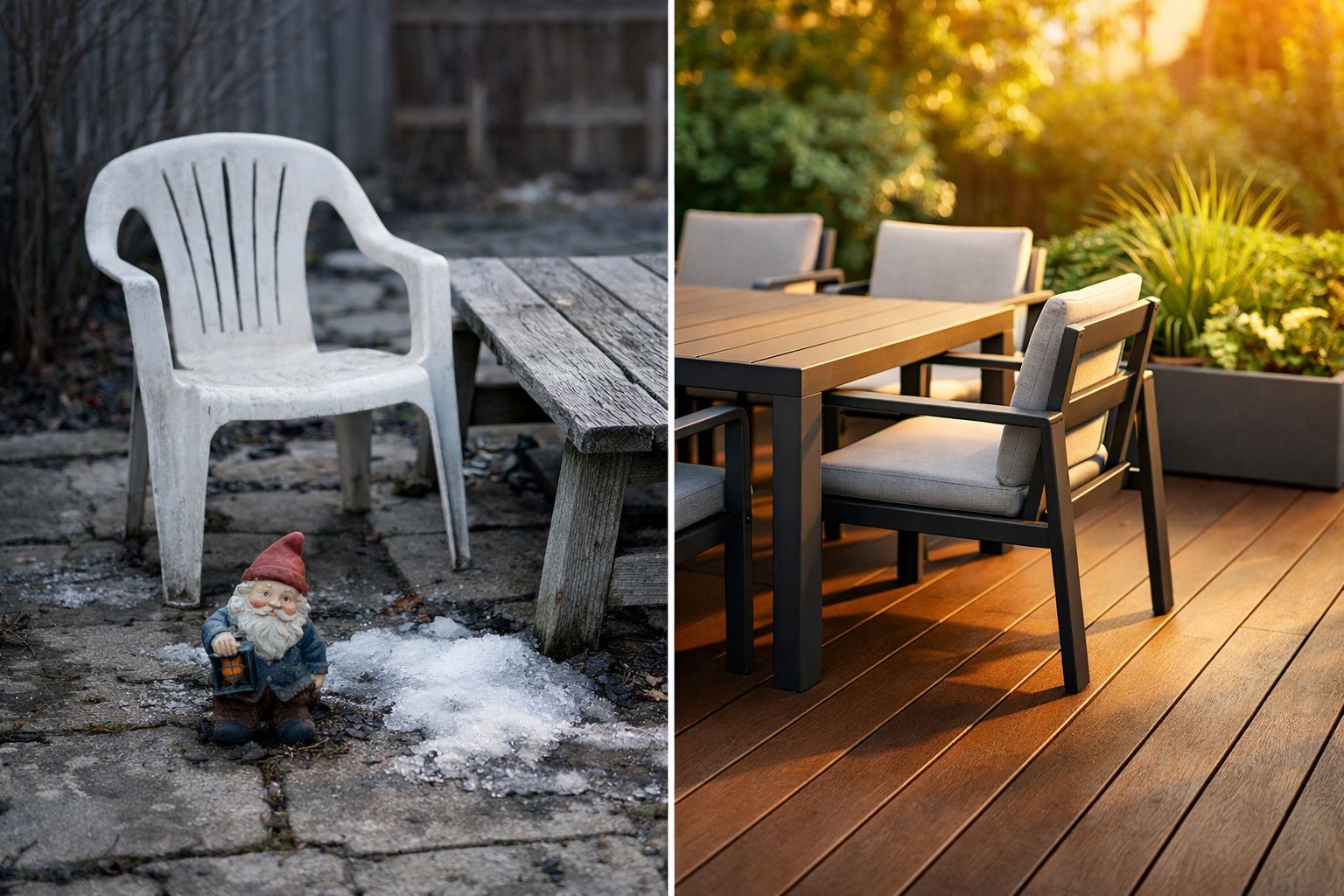
When one winter is all it takes to destroy your garden furniture
Imagine a late-afternoon coffee on a varanda in March, and instead of a cosy outdoor corner you’re greeted by a cracked bench, chairs that wobble and stains nobody asked for. That’s usually the point when it becomes clear: some outdoor materials simply are not built for real weather, and they end up costing far more than they save.
In Portugal, especially in the Norte, on exposed terraces or in places where winter brings long spells of rain and damp, outdoor furniture takes a beating. It isn’t just a bit of drizzle. It has to deal with wet weeks, cold nights, temperature swings and repeated soaking and drying. That cycle is rough.
Water works its way into tiny pores and gaps in the material. When the temperature drops, that trapped moisture freezes and expands. With every cycle, the pressure inside those micro-cracks rises, slowly forcing apart coatings, joints and even solid panels.
It’s not the cold you feel on your skin that does the worst damage, but the invisible freeze–thaw beating your furniture takes all winter.
Paint or varnish starts peeling in flakes. Wood swells and then dries out, losing shape and strength. Screws loosen. Joints open up. What looked perfectly fine in the shop can quickly feel flimsy and unsafe.
Once moisture gets deep into the core of a material, the damage usually does not reverse. Wood can begin to rot from the inside. Particle boards fall apart. Plastics weakened by UV exposure become brittle and snap. That “bargain” you brought home last spring can turn into bulky rubbish before it even reaches a second summer.
Cheap softwood and standard plastic: the outdoor money pit
Why untreated wood is a sponge in disguise
Budget garden sets often rely on light softwoods such as spruce, fir or untreated pine. At first glance, they look fresh and natural. The problem is that outdoors they behave like a sponge left on the patio.
Without deep industrial treatment, this kind of wood keeps soaking up rainwater again and again. Once it stays damp, fungi and wood-boring insects find the ideal conditions to spread. By the end of one wet winter, that “light Scandi look” can turn dark, soft and unstable.
Untreated softwood may be fine indoors, but outdoors it’s like leaving cardboard in the rain and hoping for the best.
Home-applied oils, stains or thin varnishes help a bit, but they mostly protect the surface. As soon as cracks appear or you skip a season of maintenance, moisture gets in and the slow breakdown begins.
Standard plastics and bargain resin: cracked by cold and sun
The other common trap is cheap plastic: stackable white chairs, colourful resin armchairs and low-cost loungers that fill supermarket aisles every spring. They promise “no maintenance” and low prices. Reality is less forgiving.
Summer sun hits the plastic first. UV light breaks down its structure and makes it brittle. Then winter comes, and the cold stiffens that weakened material. A small knock, or even someone sitting down a bit too sharply, can be enough to split the seat or break an armrest.
- UV light makes low-quality plastic chalky and fragile.
- Cold temperatures increase rigidity and reduce flexibility.
- Combined, they turn a flexible chair into something that shatters like glass.
These products are often too bulky for normal household waste and difficult to recycle because of mixed plastics and metal inserts. So they end up as awkward clutter in sheds, garages or, worse, at the tip after only a couple of seasons.
Aluminium and composites: the materials professionals actually choose
Aluminium: light, rust-free and unfazed by winter
Landscape designers and outdoor hospitality spaces tend to be very practical: they choose what lasts. Aluminium is high on that list. Unlike steel, it doesn’t rust. Unlike iron, it doesn’t need constant repainting just to survive.
Modern aluminium garden furniture is usually powder-coated, which means the colour is baked on at high temperature. That thick finish stands up to rain, frost and UV much better than ordinary brush-on paint.
Good aluminium furniture can stay outside all year, need a quick wash in spring, and still look respectable a decade later.
It’s also light, so it’s easy to move when you want to shift into the sun or bring furniture under cover before a storm. For balconies and rooftop terraces, that weight saving matters just as much as durability.
Composite materials: wood look, without wood’s headaches
For anyone who dislikes the sleek metal look, composites offer a convincing alternative. These are engineered materials that combine wood fibres with high-performance plastics. The result is boards and slats that resemble timber but act more like a weatherproof shell.
Good quality composite:
- does not rot or attract wood-eating insects
- resists cracking and splintering under frost
- fades slowly and evenly instead of streaking or patching
- can be washed down rather than sanded and recoated
That makes composite a strong option for decking, benches and table tops that stay exposed all year. On a terrace in Glasgow or Minneapolis, where winter seems to go on forever, that predictable behaviour matters much more than a “natural” label on a price tag.
Pressure-treated timber: keeping the warmth of real wood
Some people simply want the feel and smell of real wood outdoors. That doesn’t mean they have to accept materials that fall apart on their own. Pressure-treated timber, often pine, belongs in a different category from untreated softwood.
During treatment, protective agents are forced deep into the wood under pressure. This reduces how much water it can absorb and makes it far less attractive to fungi and insects. Used properly, this kind of timber can remain structurally sound outdoors for a decade or more.
Weathered grey on the surface doesn’t always mean rotten wood; with pressure-treated timber it’s often just a cosmetic patina.
That’s why play areas, decks and public benches often use pressure-treated boards. They still need some care and sensible design to avoid standing water, but they cope far better with a typical British or northern US winter than basic pine garden sets.
From disposable to durable: changing how you buy for the garden
Buying the cheapest set in the spring sales can feel clever at the checkout. That feeling disappears when you’re dragging broken chairs to the recycling centre two years later. Replacing full garden sets every few seasons has a financial cost and a clear environmental one.
Moving towards longer-lasting materials changes the whole rhythm of your outdoor space. Aluminium frames, decent composites and high-grade pressure-treated wood cut waste and reduce the yearly maintenance jobs that never quite get done.
| Material | Typical lifespan outdoors | Maintenance level | Winter risk |
|---|---|---|---|
| Untreated softwood | 1–3 years | High (regular staining, repairs) | Rot, warping, splitting |
| Low-grade plastic | 2–5 years | Low, until it fails | Brittle cracks, UV damage |
| Aluminium (powder-coated) | 10+ years | Low (wash when needed) | Colour fading if very low quality |
| Wood–plastic composite | 10–20 years | Low (cleaning only) | Some fading, dirt build-up |
| Pressure-treated timber | 10–15 years | Moderate (occasional protection) | Localised rot if poorly installed |
Look at it over a decade, and repeatedly buying cheap plastic or untreated wood can cost more than a single well-chosen aluminium or composite set. You also avoid the yearly frustration of finding your chairs stained, warped or mysteriously cracked after one hard frost.
Key terms and real-life scenarios
A few technical terms come up often when talking about outdoor materials:
- Freeze–thaw cycle: the repeated freezing and thawing of water inside materials, which widens cracks and weakens the structure.
- Powder coating: a dry paint applied electrostatically to metal, then baked on, creating a harder and more durable finish than liquid paint.
- Pressure treatment: an industrial process that forces preservatives deep into timber cells, making them more resistant to moisture and biological attack.
Picture two neighbours on a typical street in Portugal with a sheltered patio and a bit of winter rain. One buys a trendy untreated wood set from the supermarket every time the sun appears. The other spends more upfront on a modest aluminium table and composite chairs. After five years, the first has paid out several times, filled skips with broken furniture and still rushes to cover everything at the first sign of rain. The second hosed the furniture down once in spring, wiped it off, and went back to tending the tomatoes.
There is still room for compromise. Many households mix materials: an aluminium table with pressure-treated wooden planters, or a composite deck with a couple of carefully chosen, sheltered wooden accent pieces. What matters is knowing which materials shrug off winter and which age badly and cost a fortune, long after the receipt has disappeared from your pocket.






Comentários
Ainda não há comentários. Seja o primeiro!
Deixar um comentário