
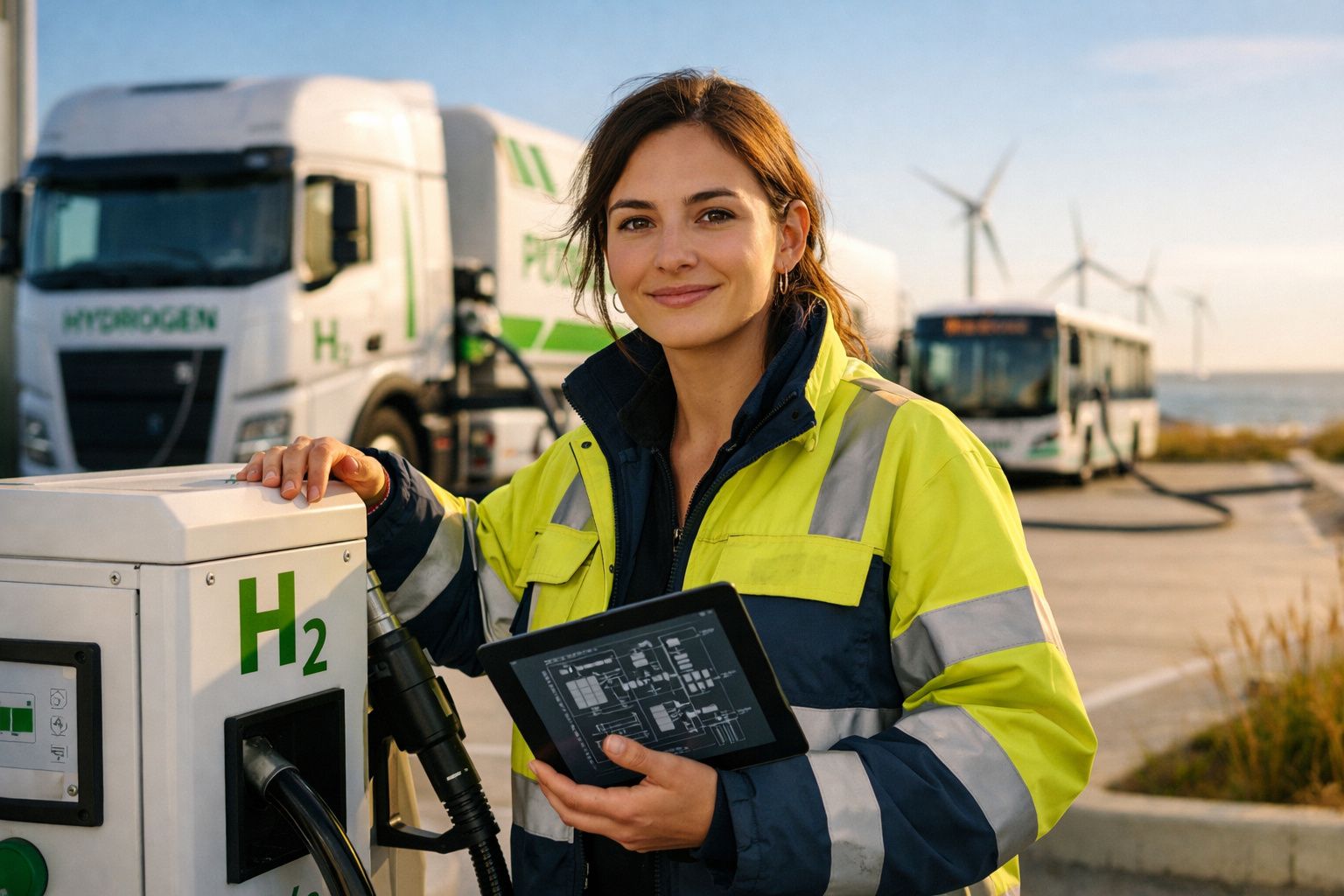
The little-known French pioneer behind wind-to-hydrogen
Enquanto a conversa sobre hidrogénio costuma ficar presa a anúncios grandiosos e promessas para “daqui a uma década”, há uma empresa francesa de média dimensão que já pôs o conceito a funcionar no terreno: produzir hidrogénio verde certificado diretamente a partir de energia eólica, em escala industrial, e fornecê-lo a autocarros, camiões e fábricas - não a apresentações bonitas.
Chama-se Lhyfe e, longe dos holofotes, conseguiu transformar aquilo que muitos gigantes da energia discutiram durante anos numa operação real, com produção contínua e entregas a clientes que precisam do gás todos os dias.
Green hydrogen is produced by splitting water into hydrogen and oxygen using electricity from renewable sources such as wind or solar. The gas can then replace fossil fuels in areas where batteries struggle: heavy industry, long-distance trucks, shipping, trains and large bus fleets.
Lhyfe did not invent electrolysis. Its big idea lies in how the technology is organised on the ground. Instead of placing giant electrolysers far from energy sources and customers, it builds compact plants close to both. That cuts transport losses, grid connection costs and paperwork.
Lhyfe’s model is simple: put production units next to wind or solar farms, and next to the factories, depots and stations that actually need the gas.
World first on the Atlantic coast
Since 2021, Lhyfe has been operating a site in Bouin, in the Vendée region on France’s Atlantic coast. On paper, it looks modest. In practice, it is a global first: a wind-powered plant producing green hydrogen in a fully autonomous way.
The unit sits near onshore turbines, draws electricity directly from them, and turns it into hydrogen day after day. There is no simulation, no lab conditions. The system has to deal with salty air, fluctuating winds, maintenance windows and real-world logistics.
This demonstrator has become a testbed for a new kind of energy infrastructure. Engineers can see how electrolysers behave with variable wind output, how to stabilise production, and how to plan deliveries for customers who need reliable supply.
Near Chambéry: 400 kg of green hydrogen a day for buses
On the eastern side of France, near Chambéry in Isère, Lhyfe is rolling out another key project. Backed by European funding, the site is due to produce around 400 kilograms of green hydrogen a day from 2026.
The gas will feed regional bus fleets, helping local authorities cut diesel use without waiting for expensive new infrastructure. The idea is that once a core station is in place, more vehicles can switch, and other users – such as logistics depots or municipal trucks – can be added.
Lhyfe describes this as a territorial supply chain: relatively small but well-located units, each anchored in a local network of transport and industry.
- Location: near Chambéry, Isère, southeastern France
- Target: about 400 kg of green hydrogen per day
- Main use: regional bus fleets and local mobility
- Support: European funding and regional partners
Instead of one huge hydrogen hub feeding half a continent, Lhyfe is betting on a dense web of smaller, decentralised sites close to end users.
2026: when the economics start to bite
Up to now, green hydrogen projects have largely been judged on ambition and symbolism. From 2026, the financial equation sharpens, and Lhyfe knows it.
The company has set itself a tough target: cut production costs by 30 percent. That will not come from a single shiny new plant, but from grinding optimisation work.
From expansion at all costs to tuning what already exists
Lhyfe is shifting part of its focus from announcing new sites to optimising existing ones. That includes:
- Improving electrolyser efficiency and durability
- Sharing infrastructure between nearby units where possible
- Automating operations and monitoring to reduce staffing costs
- Refining logistics and cylinder/transport management
Falling costs for wind and solar power help the equation, since electricity is the biggest factor in the final price of green hydrogen. At the same time, Lhyfe is seeking long-term offtake contracts with local authorities and industrial clients so it can plan investments years ahead.
By the end of 2026, the company aims to have 11 sites operating or under construction in Europe, with a combined target of around 80 tonnes per day. The long-term roadmap mentions up to 9.8 gigawatts of installed capacity by 2030 if market conditions and policy support hold.
A key piece in Europe’s hydrogen puzzle
The European Union no longer treats green hydrogen as a distant bet. Brussels has set a target of 40 gigawatts of electrolyser capacity by 2030, producing about 10 million tonnes of green hydrogen a year, with another 10 million tonnes expected from imports.
The idea is to use that gas to decarbonise steel, chemicals, refining and hard-to-electrify transport. This is not just about swapping fuels. Large parts of European industry will need to change equipment, processes and supply contracts.
New rules, especially the RED III directive, put pressure on heavy industry to shift. Targets foresee hydrogen-based sources covering 42 percent of industrial energy consumption by 2030, rising to 60 percent by 2035.
EU support already totals around €20 billion through various funds and schemes, signalling that green hydrogen is no longer an optional side project.
France’s targets and the reality check
France wants to install 4.5 gigawatts of electrolysers by 2030 and 8 gigawatts by 2035. That would allow production of roughly 520,000 tonnes of low-carbon hydrogen a year.
The reality on the ground is more modest for now. By 2024, only about 308 megawatts were actually installed. The gap shows how hard it is to turn national strategies into concrete plants, permits and customer contracts.
Companies like Lhyfe sit at the centre of this tension. They need public aid for early projects, yet they also need to show that the business can stand on its own feet. The next few years will test whether decentralised green hydrogen can scale without exploding costs.
A motorway station for lorries points to a new freight era
One project already hints at what decarbonised freight might look like on the ground. Since November 2025, Lhyfe has been supplying hydrogen to France’s first motorway service station for heavy goods vehicles.
Operated by TEAL Mobility on the A4 in the Grand Est region, the station can distribute about one tonne of hydrogen per day. With both 350-bar and 700-bar dispensers, it can refuel articulated lorries as well as lighter vehicles.
The location is strategic. The A4 offers direct routes toward Germany, Luxembourg and Belgium, all major logistics corridors. The station effectively becomes a hydrogen gateway between western and central Europe.
Lhyfe delivers gas certified under the EU’s RFNBO standard, which strictly defines which hydrogen can be labelled renewable and used to meet European targets. Behind the scenes, a fleet of more than 70 high-pressure containers and four RFNBO-certified production sites in France and Germany keeps the supply chain running.
Why green hydrogen matters for trucks and buses
| Use case | Battery electric | Green hydrogen |
|---|---|---|
| Urban buses | Works well, short routes, depot charging | Useful for longer routes and fast refuelling |
| Long-haul trucks | Heavy batteries, reduced payload | Lighter tanks, quicker refuelling on corridors |
| Industrial vehicles | Feasible but may require long idle charging times | Can refuel during short maintenance windows |
For motorway freight especially, hydrogen offers a way to decarbonise without sacrificing range and payload. That is why the A4 station – though small in capacity – is watched closely by logistics operators and policymakers.
What “green” hydrogen actually means
The term hydrogen covers very different realities. Most of the hydrogen used today in refineries and for fertilisers is made from natural gas, producing significant CO₂ emissions. That is often called “grey” hydrogen.
“Green” hydrogen, by contrast, uses renewable electricity and water, with almost no direct emissions. In between, some speak of “blue” hydrogen, derived from fossil fuels but combined with carbon capture and storage. These labels matter, because subsidies, regulations and corporate pledges typically apply only to the cleanest versions.
RFNBO certification in the EU adds yet another layer. To qualify, producers must prove that the electricity used is genuinely renewable and additional to what already exists on the grid, and that time and geographical matching rules are respected. For companies like Lhyfe, this creates extra complexity but also a clear advantage if they can comply at scale.
Risks, bottlenecks and what could go wrong
The momentum around Lhyfe and its peers does not mean success is guaranteed. Several risks stand out.
- Electricity price volatility: high wholesale prices can kill the business case overnight if long-term contracts are missing.
- Slow permitting: local opposition or administrative delays can stall new wind, solar and hydrogen facilities.
- Competition from cheap imports: hydrogen shipped from regions with intense sun or wind, and lower labour costs, might undercut European producers.
- Technology race: improvements in batteries, biofuels or nuclear-derived hydrogen could shift attention and funding.
Lhyfe’s decentralised model partly addresses these issues by reducing dependence on big grid connections and spreading risk across many sites. Still, each unit needs reliable customers, and the upfront investment remains heavy for a mid-sized player.
How this could affect everyday life
For most people, green hydrogen feels abstract. Yet if projects like those run by Lhyfe succeed, the effects will be visible in ordinary routines.
Regional buses could run on hydrogen produced a few kilometres away, cutting diesel fumes at school gates. Supermarket goods might arrive on lorries refuelled at motorway stations using wind power from the coast. Industrial zones could slash emissions without moving plants abroad, limiting the risk of job losses.
Even small towns might host compact electrolysers linked to a handful of turbines or rooftops, providing fuel for bin lorries and local bus lines. In some regions, hydrogen from these units could feed nearby factories making glass, steel or chemicals, tying local employment directly to the energy transition.
For now, Lhyfe remains a relatively discreet name. If its bets on decentralised green hydrogen pay off, that anonymity may not last very long.





Comentários
Ainda não há comentários. Seja o primeiro!
Deixar um comentário