
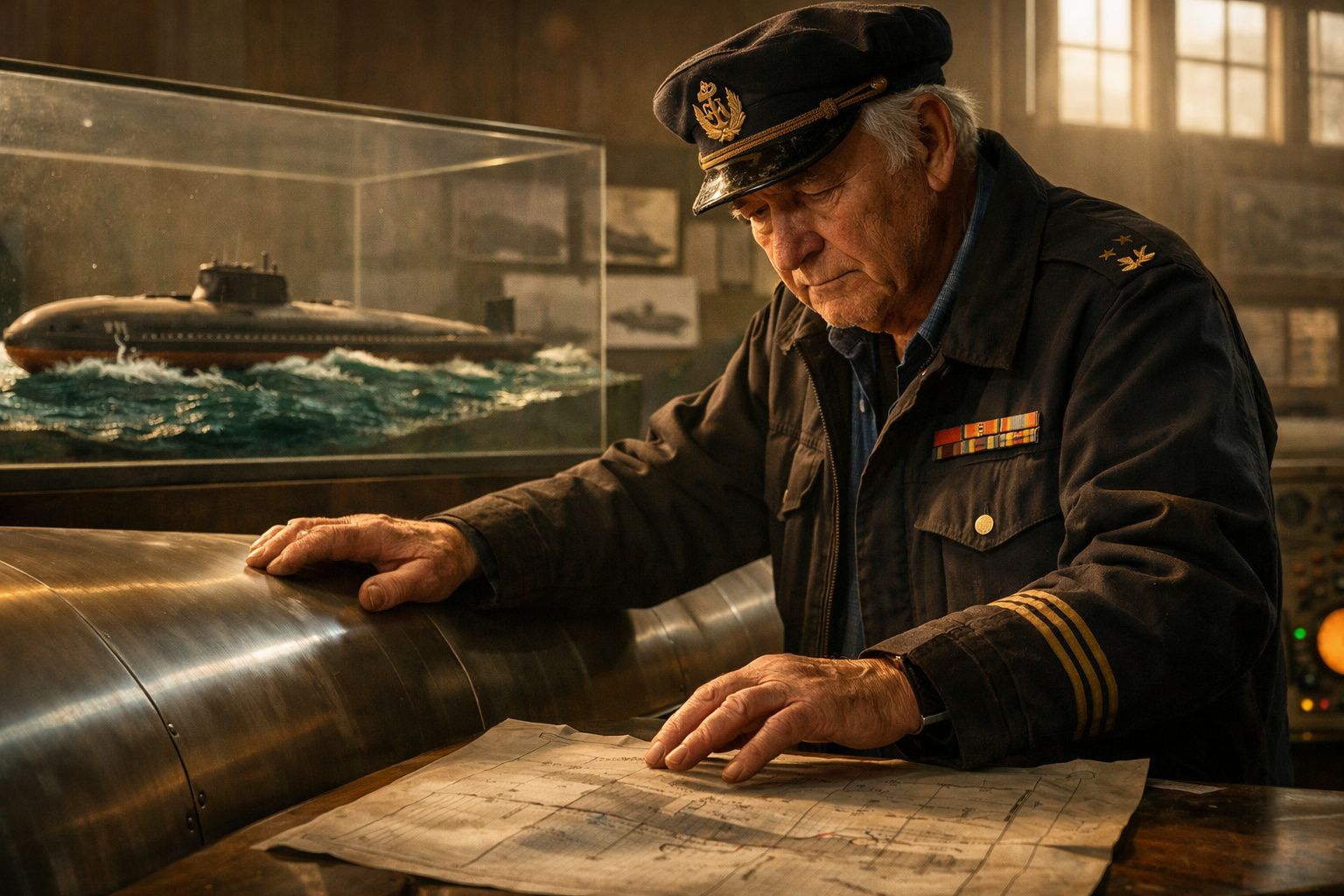
The day the ocean learned what 44.7 knots really feels like
Navy records can sometimes sound abstract - until you picture a submarine turning speed into a near-explosive event underwater. In 1970, that’s exactly what happened in the Barents Sea, when a Soviet boat pushed so hard that the whole crew felt it in their bones. The sea above stayed calm, but inside the control room the mood was anything but: gauges climbed, the hull trembled, and sailors knew they were approaching a limit no one could treat lightly. By the time the run ended, the K-222 had done more than set a mark. It had created a legend that still unsettles naval specialists and veterans alike.
This was the K-222 - the world’s fastest submarine, and very possibly its most divisive.
Ask former Soviet submariners about the K-222 and you usually get a blend of pride and discomfort. They’ll describe a boat that could leave torpedoes behind, surging up from the depths like an underwater projectile. They’ll also talk about noise so brutal it seemed as if the hull might split, and about controls that felt less like navigation and more like keeping the thing together for one more minute. The K-222 was not merely fast. It was a challenge thrown straight at physics.
Speed records look glorious on paper. In a steel tube, hundreds of metres below the surface, they feel much closer to tempting fate.
The official Soviet trials said the K-222 reached around 44.7 knots submerged, roughly 82 km/h. For comparison, modern attack submarines usually operate closer to 25–30 knots, and sometimes less when they need to stay quiet. That figure - 44.7 - became both a badge of honour and a burden. Stories spread that NATO sonar operators could detect the K-222 from absurd distances, long before they could identify her position.
Some veterans remember that, during high-speed runs, tools and small components would literally shake loose from their mounts. One described standing in a corridor and feeling the whole vessel vibrate “like a nervous animal trying to break its own skin.” On the logbook, the speed looked spectacular. On board, it was something else entirely.
The reason wasn’t magic. It was material. The K-222’s hull was made of titanium, a wonder substance in the Soviet imagination of the 1960s: lighter, stronger, resistant to corrosion, and brutally expensive to work with. Titanium allowed the Rubin design bureau to sketch a sleeker, lighter submarine, built for deeper dives and eye-watering speed. But that bold decision came with trade-offs engineers still debate today: staggering production costs, difficult welding, and unpredictable fatigue.
The hydrodynamic design chased pace above everything else, not silence or crew comfort. That’s where the divide starts: admirers see a fearless technological leap; critics see a noisy, impractical prototype that delivered hard lessons at a heavy price.
The beautiful, brutal logic behind chasing underwater speed
If you step back from the headline speed figure, the K-222 starts to look less like a monster and more like a question cast in metal: what happens when a submarine wins the race for speed and loses almost everything else? During the Cold War, Soviet planners were fixated on one nightmare scenario - NATO carrier strike groups getting close enough to launch nuclear attacks. A submarine that could dart in, launch missiles, and then sprint away sounded ideal. Speed promised survival.
On paper, the logic was neat. In the water, it was messy, noisy, and punishing for the crew.
Take one well-known episode told by former officers: during trials, the K-222 reportedly charged so fast towards an American carrier group that NATO ships scrambled, baffled by the sudden, booming acoustic signature. They heard “something huge and angry” beneath the surface but struggled to track it precisely. The K-222’s designers loved that story. To them, it proved that a fast, frightening submarine could punch holes in Western doctrine.
But the same story has a darker edge. The crew knew that while they were hard to pinpoint accurately, they were impossible to ignore. Like slamming a door in a quiet room, their presence announced itself long before it had any tactical value.
This is where experts still disagree. One camp says the K-222 was a glorious dead end: too costly, too noisy, too maintenance-heavy, a kind of underwater drag racer unmatched in a straight line and useless at almost everything else. Another camp sees it as a harsh but necessary experiment that advanced Soviet metallurgy, hydrodynamics, and reactor design.
The plain truth? Both views can be right, depending on what you believe submarines are really for. If the goal is pure speed and intimidation, the K-222 looks brilliant. If the goal is stealthy patrols over long periods and on a tight budget, it starts to look like an extravagant mistake forged in titanium.
Why veterans still argue about a boat that barely served
Speak to retired Soviet and Russian navy men, and the K-222 often comes up like a family secret: everyone remembers her, but nobody agrees on what she meant. Some served alongside her in other boats and recall her as almost mythical within the fleet. Others shrug and call her a one-off showpiece that spent too much time in dry dock. The reality is that K-222 had a remarkably short operational life for such a famous machine.
Her reactors were powerful, but demanding. Her titanium hull, while strong, turned every repair and refit into a nightmare of cost and complexity.
We’ve all had that moment when a bold idea we once admired starts to look... a bit reckless in hindsight. Submariners feel that very sharply. Many trained on more conventional boats that valued silence and reliability above all else. From that perspective, seeing huge resources poured into one fast, fragile prototype felt almost like a betrayal of what kept crews alive.
Some younger officers, though, quietly loved the audacity. For them, K-222 proved that the Soviet navy could aim high, not just copy Western ideas with a delay.
One former officer summed it up bluntly years later: “She was the fastest corpse in the ocean. We were proud of her and afraid of her at the same time.”
- The titanium hull: stunning on paper, a nightmare in the shipyard.
- The double reactor setup: immense power, constant vigilance, little mercy for mistakes.
- The acoustic signature: a warning siren to anyone listening across half an ocean.
- The maintenance burden: high costs in a system already stretched thin.
- The symbolism: a prestige project in a navy that still needed dependable workhorses.
What the K-222 really left behind under the waves
Today, the K-222 is gone, cut up for scrap, with her titanium bones quietly sold off in the 2010s. On paper, her peak speed remains unbeaten. In practice, no navy has seriously tried to surpass it. That isn’t just about money or changing strategy. It’s a quiet admission that the race for underwater speed was a seductive illusion. The world’s best submarines now lean towards stealth, automation, and low acoustic signatures, not raw pace.
Even so, the ghost of K-222 still shows up in debates about unmanned underwater vehicles and high-speed torpedoes. The dream of outrunning danger never really dies; it just changes shape.
| Key point | Detail | Value for the reader |
|---|---|---|
| Record speed | Approx. 44.7 knots submerged, still unmatched | Helps explain why K-222 became both a legend and a controversy |
| Titanium hull | Light, strong, incredibly costly and hard to repair | Shows how cutting-edge materials can both advance and limit a project |
| Strategic lesson | Raw speed lost out to stealth, reliability, and cost control | Offers a clear lens on why some “world firsts” don’t shape the future |
FAQ:
- Was the K-222 really the fastest submarine ever built? As far as open sources and declassified data go, yes. No confirmed submarine has exceeded its recorded submerged speed of around 44.7 knots.
- Why didn’t the Soviet Union build more submarines like it? The cost and complexity of working with titanium, combined with the boat’s extreme noise and maintenance issues, made large-scale production unrealistic.
- Could modern technology build a better, faster version today? Technically, yes, but navies prioritise stealth and endurance over raw top speed, so there’s little incentive to chase that record.
- Was the K-222 considered a success inside the Soviet navy? Opinions were split. Some leaders saw it as a technological milestone, others as an overengineered prototype that didn’t fit operational needs.
- Why does the K-222 still fascinate experts and fans? Because it sits at the edge of what was possible, a rare case where engineering bravado collided head-on with harsh reality under thousands of tonnes of water.





Comentários
Ainda não há comentários. Seja o primeiro!
Deixar um comentário